Sweet Chestnut vs. Horse Chestnut: A Cook's Identification Guide
Every October, someone fills a bag with conkers and asks whether they can be roasted. It is an easy mistake, and in a kitchen it is an important one. Sweet chestnuts are a genuinely fine ingredient. Horse chestnuts are not food. The two trees share parks, streets and woodland edges, they ripen at almost the same moment, and both drop glossy brown nuts that look, at a glance, worth gathering. The reassuring part is that you never have to judge by the nut alone. Leaves, husks and the nut's own geometry will settle the question, and once you have learned the three checks below you can sort a mixed bag on a kitchen table in a minute.
If the tree is still in leaf, you have your identification before you even bend down. The two species hold their leaves in completely different ways, and the difference is obvious from a metre away.
Castanea sativa carries a simple leaf — a single long blade, roughly 15 to 20 centimetres, lance-shaped and slightly leathery. The upper surface is a deep, glossy green; the underside is paler and faintly downy along the midrib. The edges are the giveaway: sharply and regularly toothed, like a fine saw, with the veins running straight out to each point. Leaves alternate along the shoot rather than sitting in pairs.
Aesculus hippocastanum is not a chestnut at all — it belongs to the soapberry family — and its leaf is palmate and compound. Five, sometimes seven, broad paddle-shaped leaflets radiate from a single point like the fingers of a spread hand. Each leaflet is much wider than a sweet chestnut leaf and the teeth along its edge are softer, more rounded, with veins that curve rather than running straight out. Hold a leaf up and count the leaflets. If there is more than one, walk away.
Husks are where people get careless, because both are green and both are spiny in a loose sense. The spines themselves are not alike.
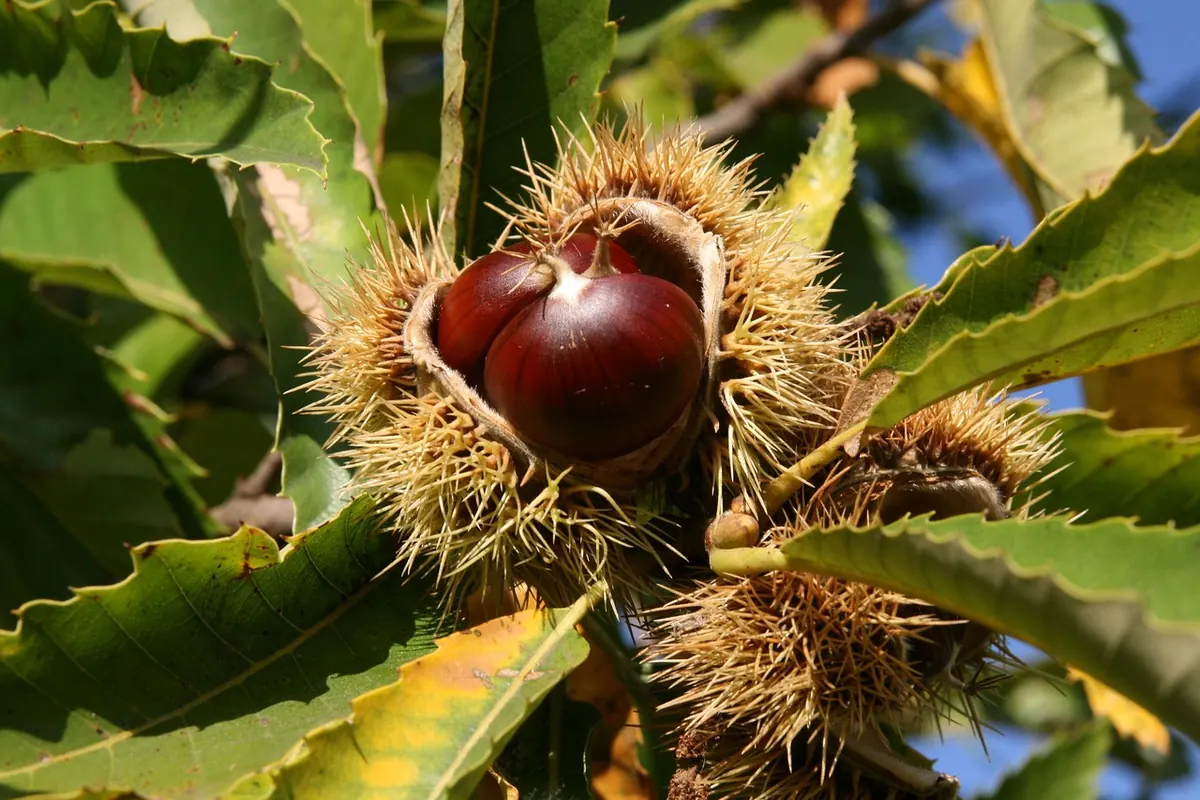
A sweet chestnut husk is a dense, needle-fine case, closer to a sea urchin than anything else. The spines are long, thin and crowded so tightly that you cannot close your hand around one without regretting it. When it ripens it splits into four valves that open like a star, usually revealing two or three nuts nestled inside — sometimes a single fat one that has crowded out its neighbours. The colour shifts from green to a straw brown.
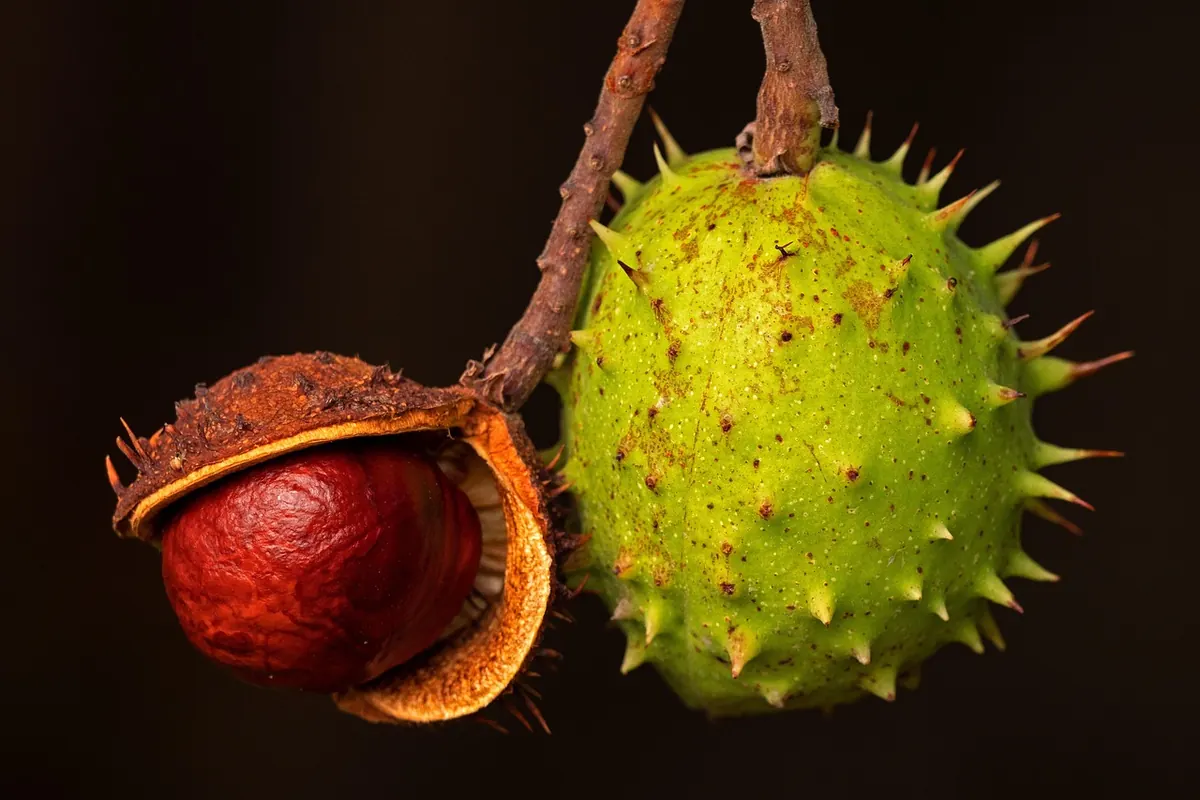
A horse chestnut husk is leathery and thick, with a handful of blunt warty bumps spaced across its surface. It feels like a golf ball with a few knobs on it, and you can pick one up bare-handed without pain. It splits into two or three chunky valves and normally holds one large conker, occasionally two.
Practical tip: carry a pair of thick gloves and wear boots you don't mind scuffing. Kicking a husk open on tarmac is faster than wrestling it with your fingers, and it keeps the spines out of your palms.
Once the husks are off, look at the nuts in good light. There are three features worth checking, and any one of them is usually enough.
Colour helps a little but is not decisive. Both are mahogany-brown and both are glossy when fresh. Sweet chestnut skin often carries faint darker stripes and can be slightly duller; conker skin is deep, even, almost lacquered. Inside, sweet chestnut flesh is dense cream and snaps like a raw carrot, while horse chestnut flesh is pale yellow and waxy. I would not recommend tasting as a test — a horse chestnut is bitter and soapy, and that is a mouthful you don't need.
Winter identification is harder but not impossible. Sweet chestnut bark on a mature tree is deeply ridged, and the ridges tend to spiral around the trunk like twisted rope. Horse chestnut bark is smoother and grey, flaking in plates that sometimes show a faint pinkish tinge. In winter the horse chestnut also carries big, shiny, sticky buds that are quite unmistakable.
Flowering separates them cleanly. In late April and May the horse chestnut lifts upright white cones — the "candles" — above the leaves. Sweet chestnut flowers come much later, in June and July, as long creamy-yellow catkins with a heavy, sweetish, slightly musty smell that hangs over a whole wood.
Timing is a useful cross-check in autumn, too. Horse chestnuts usually drop from late August while the leaves are still green, and those leaves often turn brown and crisp by early September, well ahead of everything else. Sweet chestnuts start in late September and continue into November depending on region and altitude, and the foliage is still green or just turning yellow when the first husks hit the ground.
A few popular tests simply don't work, and it's worth knowing why.
The reliable method is a three-point check: a leaf from the tree above, a husk if you can find one, and then the nut. Two out of three matching sweet chestnut is a comfortable margin. One out of three is not.
Empty the bag onto a table in decent light and work through it in order.
Remember that sweet chestnuts are a cooking ingredient, not a snack straight from the shell — they need roasting, boiling or grilling, and the bitter inner skin has to come off while they are still hot. Horse chestnuts should never reach the pan at all; keep them for the children's games and the compost heap. If a child or a dog does eat one, ring your doctor or poisons service promptly rather than waiting to see what happens — that is a conversation for a professional, not a recipe page.
Learn the leaf first, then the husk, then the tuft and the scar, and the whole business becomes second nature. After a season or two you will find you can spot a sweet chestnut tree from a moving car, and that is when the autumn kitchen really opens up.
Photo: Nennieinszweidrei / Pixabay
Previous Post
Chestnut Foraging Checklist: Gear, Timing, and What to Leave Behind
Next Post
7 Common Mistakes When Foraging and Cooking Wild Chestnuts